Monthly Archives: November 2014

Final Random Notes from Carter

A billboard of a massive Michael Phelps, our hometown Olympian, arms outstretched (pitching a new Speedo product) and towering over the streets of the boozy town of Ushuaia, Argentina strangely comforted me, making me think of home, in the way seeing an R.E. Michel Company truck always makes me think of my dear old Dad. Now, I hate chain stores and market saturation as much as the next person, but every time I saw the nearly ubiquitous UnderArmour brand (a Baltimore-based company), I took it as a virtual hug to my psyche.

Finally, I remember seeing a big, squat letter ‘G’ sticker on the back of a car when we were in Delhi. Instantly, I thought “Gilman!”- the school my nephew attends. One of the boys said, “It’s Georgetown!”- where another nephew goes to school. Harry said, “Greenbay Packers!” I think it ended up being for Greece…The point being, it’s all about how things relate to you. The world’s a big place, but our personal worlds are small and those we love, or have loved, act as our lens, no matter the distance of the journey.

-carter

Over Time You Realize You Know Less and Less

Our caustic, well-educated guide Nandan told us, “You’ll never understand India from your full-bellied Western haunch.” He made me feel defensive because in fact, I’d made it all the way to India, but he got me thinking all the same.

I challenged myself to reflect on what I’d already seen and to evaluate for the rest of the trip the question, “What do we really know, firmly believe to be true?” I started by thinking it’s what we’re taught by a knowledgeable insider, then by what we see, next by what we experience and finally, what we feel.

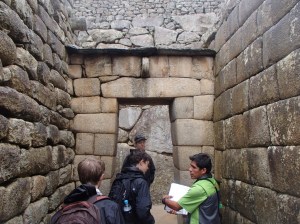
TAUGHT. On our 4 day trek on the Inca Trail to Machu Picchu, our part-saint, part-devilish guide Sabino taught us all day long. He’d grown up in a nearby town and had been guiding for decades. Some of the fascinating details, such as the design of the water system piped throughout the community over 500 years ago led me to take notes. At Machu Picchu, our guide left us; feeling physically challenged and delighted with our newly-acquired knowledge, we were handed over to Raul, head of the company, for the drive back to Cusco. Raul was a captivating teacher himself and we paid close attention when he explained the plumbing of the ingenious Incan engineers. Well, if he didn’t explain it exactly opposite, and more logically, than what we’d just learned..

20130406-231455.jpg

SEE. On South Georgia, two baby penguins chased their mother for food. A hilarious battle reminiscent of human childhood tussles. So cute. Such antics. Wrong. One will live. One will die. Whoever gets that food will survive.DSC_0261
EXPERIENCE. There are low and high context cultures; the former, where what you see is what you get. America is a low context culture. Americans tend to say exactly what they mean. Indians and Japanese do not. You have to understand their culture to be able to parse the meaning of what they say (or don’t!) and how they say it. For example, in India they want to please you. If you ask for directions, they will give them to you because that is what you want. This has no bearing on whether or not they have any idea of the answer. Similarly, we stayed in hotels in India, so routinely called the front desk to ask for Internet connectivity. Regularly, the response would be, “So sorry, it will be fixed tomorrow. A repairman is coming tomorrow.” The next day we would call and get the same response. When we pointed out the inconsistency, they would apologize, “Oh you are right. The repair will be made today!” The Internet never worked anywhere we had to inquire.

We had a blast in Israel, seeing the country through the eyes of a friend we’d made in Antarctica, a non-religious Jew with a California surfer attitude. He advised us on an itinerary, even suggested we visit Bethlehem, but we did not attempt to navigate that.

Muggin' in the Dead Sea

Muggin’ in the Dead Sea

We retold our adventures on this blog to share our experiences with our friends. However, anyone can read it and one attacked our reflections virulently as one-sided and ignorant of the “apartheid regime Israel maintains for the Palestinians.” Indeed, we didn’t know anyone in the West Bank, didn’t even know how to tackle a visit. I regret that now and wish I could better understand the pressures and severe limitations put on that population. Does this negate the amazing experience we had in Jerusalem, Masada, Haifa, the Golan Heights? I think in a small way it does.

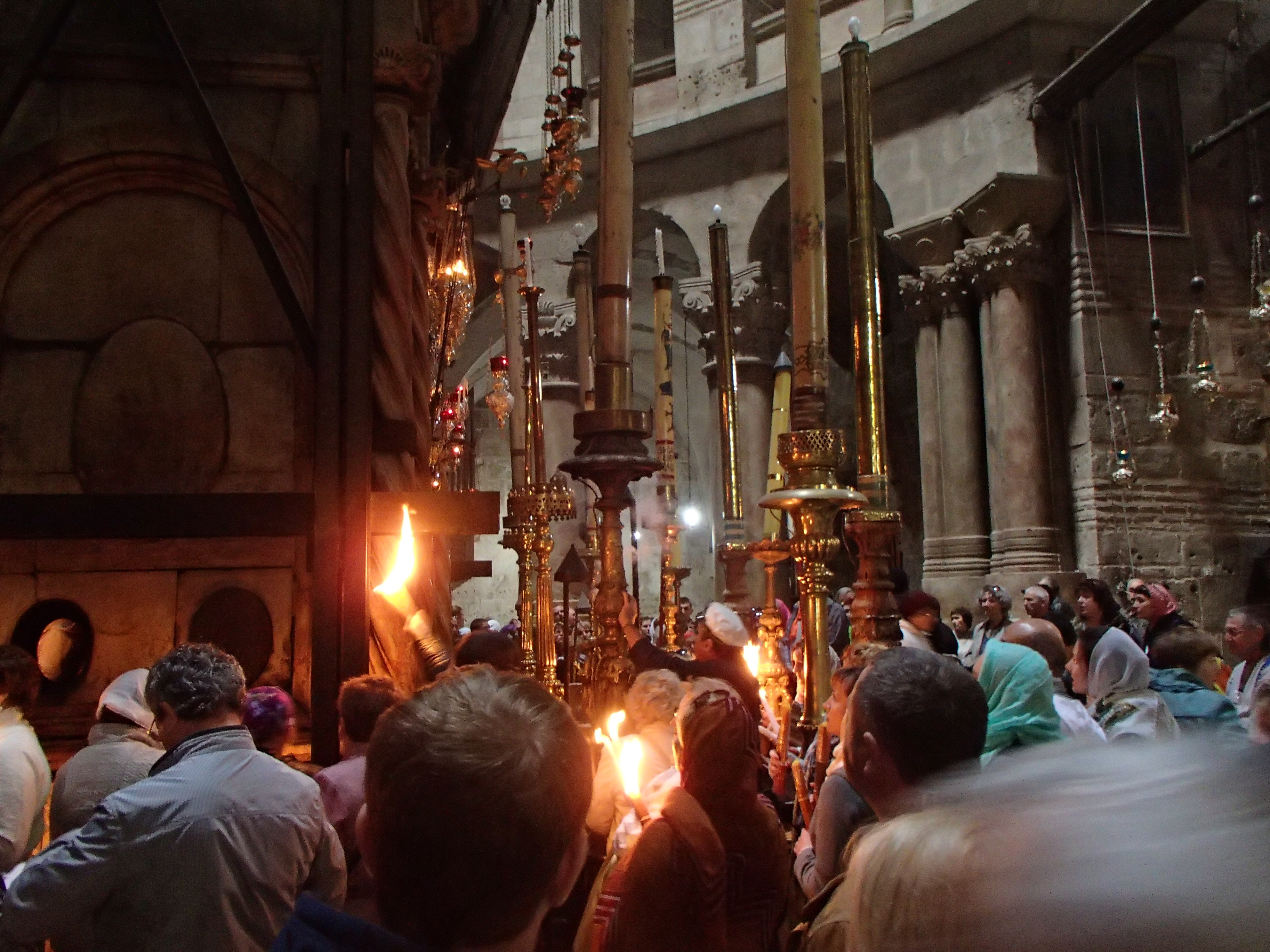
FEEL. Surely we can trust what we feel, can’t we? We went to the Church of the Holy Sepulchre, where many believe Christ was crucified, taken off the cross and placed in a tomb. Raised a Christian, I went in mindfully to witness the place. People were touching their small things (watches, rings, tokens) to the place Christ’s body was said to have laid in order to transform their objects into a relic of sorts. The mass of humanity there included a chaotic scramble of different sects that shared the same side room sanctuaries. Regularly, one group would have to remove everything in their space- including their altar and cross- while the next group replaced their items there. There was a long, heaving line waiting to see inside the tomb. They pressed forward, some pilgrims weeping, some shifting frantically. People also lined up to buy candles, which when lit momentarily created a pyrotechnic spectacle alongside the side wall of the tomb. The scene felt more akin to a bazaar than a holy site. So unfamiliar and far from my Episcopalian tradition, the power of the place was lost on me. Unattainable.
OLYMPUS DIGITAL CAMERA
However, on a recent trip to Krakow, Poland, we needed to stay a few more nights and had to stay in the Jewish ghetto. There was a palpable heaviness there, as if the pain clung to the air and the buildings. There was an unmistakable energy, power to the place.
So, though I wish it weren’t true, our Indian guide was more right than wrong. We didn’t know, we may never know, what it’s like to be anyone except the unreliable narrators that are our ever-evolving selves, but I think it is a noble and worthy pursuit to keep trying…

-carter

Video

Trip – Random Reflections 15 Months Later

On a wide-open field in a busy park in Tokyo, an elderly man walked with effort, penguin-like while holding the hand of a toddler. They were both smiling on this bright June day, but occasionally the child would gaze skyward, lose his balance and fall, limbs akimbo. This happened repeatedly. Looking straight ahead or at his feet, the boy was steady enough, but then he would look up. Boom. On the ground, again. This scene observed near the end of our trip sums up what it feels like to be back to our ‘regular’ lives, having returned some 15 months ago.

-Hanging on the bulletin board in my office are an array of items that act as a shrine to my modern society.

Image 1A Splenda packet exhorts “Forget the clean plate club! Try to avoid overeating by always leaving 3-4 bites on your plate.” A flattened pasta box extolls its newest product ‘Quick 3 Minute Rotini’ with the words, “Every minute counts in your busy life…” A Staples coupon is for a Reduced Effort Stapler. These things both exasperate and amuse me in their absurdity. Why don’t we just serve ourselves what we need, instead of extra that we will then throw in the garbage?! Are we so important that we need 3 Minute pasta instead of the stuff we’ve had forever that takes 9 minutes?! Are we so exhausted that we need help stapling?!

-In the last year, my hometown embraced gambling at the tail end of the curve for such entertainment in this country. So now, amidst our sparkling Inner Harbor, a different sort of shrine stands, a hulking edifice to easy money. Whenever I see an advertisement for the 122,000 square foot Horseshoe Casino, I think of the storefront gambling spot in Cusco, Peru where the prizes were big bags of rice and canned peaches. Imagine these foodstuffs as the dream.

-Living out of one small, easily-transportable suitcase and one school-size backpack for 6 months shifts what you know you need. We decided to massively purge the house of any unnecessary belongings that weren’t serving any of our family members. When I told a friend, who is a Maine author, about our winnowing, she wisely responded, “It begs the question, ‘What are we curating?” Having grown up with a few manic, messy members then marrying a man whose level of disorder matched my own, I now feel like I am living some sort of performance art piece. A friend wondered when I was going to unpack; it’s that bare.
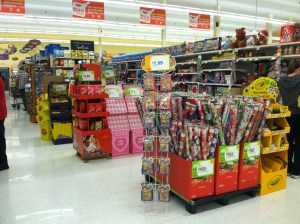
Xmas Eve picture taken at my grocery. Note the Valentine's Day display AND the Easter row behind it!

CRAPDOODLE- Picture taken at my grocery on Xmas Eve. Note the Xmas display with the Valentine’s Day display behind it AND the Easter row behind it.

-Passing through Poland Springs, Maine a flood of disparate trip stories washed over me. The Facebook Water Bottle Debate via Varanasi, India was the first. When visiting this significant Hindu city, I made the mistake of checking my computer while next to the great, holy Ganges River. Online a discussion raged between smart, thoughtful American women about the possibility of direct sunlight leaching plastic into their bottled waters. Meanwhile, kids were splashing, swimming, working in the filthy, toxic water in front of me.

DSC_0313

My family and I had been drinking bottled water for months because we had no choice; there was no reliable, clean water in the places we’d been. I resisted the impulse to reply to my virtual community. Really?! Unlike most of the world, Americans have access to clean water every day. We should buy a reusable bottle and refill it until our dying day then bequeath it to our youngest relative. Repeat.

When the boys played soccer or cricket in Vietnam and India, one of the local kids would bring a big bottle of water to share. No one would drink directly from the bottle but pour it from above into the waiting mouth.

In Matsumoto, Japan, the water is pure and clean running from the nearby mountain to open pipes through the village. People stop their cars on their way to work and fill their water bottles for the day from community-provided long handled ladles found on many street corners.
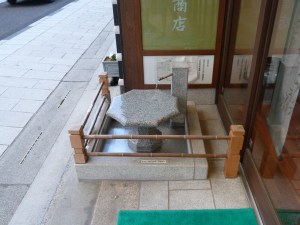
A fancier storefront offering of the rerouted water.

A fancier storefront offering of the rerouted water.

In Poland Springs, Maine, a bottle of water costs $1.92. Poland Springs’ domestic sales are an annual $ 11.8 billion and growing, for an item we do not need.

-I returned home from the trip to an improved kitchen that has a warming drawer for dishes. Heaven forbid, I serve hot food on cold plates…

Again, I am that child on the ground, befuddled with the dissonance around me and inside of me.

-carter