
The U.S. is the teenager of the world- confident/narcissistic, powerful, sports-obsessed but fun, free and tolerant. I look at our situation as any parent of a teenager does. The kid is infuriating, but he’s mine, all mine. And if the U.S. is the teenager, Baltimore is the delinquent younger brother. ‘The Wire’ is known worldwide.

Pizza Restaurant near our house specializes in everything.
CONFIDENT/NARCISSISTIC. Though our ‘We are #1!’ rhetoric has quieted down, a 2013 Brookings Institute study says 60% of Americans believe “God granted America a special role in human history.”
-After a walking tour of Kolkata, our guide Iftey sat in the back of a church and spoke with us at length about our cultural differences. He thought it was hilarious that in American shoot-‘em-up movies, like Chuck Norris films, hundreds of people are slaughtered, all utterly expendable, but an American gets a hangnail and tragedy has struck! (This changed how I viewed ‘Captain Phillips’ and for whom I rooted!)
-In contrast, we saw how the people of the African countries we visited were marginalized throughout their days. Their marketplace is full of our hand-me-downs. (I spied a Rockville Soccer Rec t-shirt.) Their cars are all second hand. The keyboards are labeled in Arabic. With a cash economy, it’s subsistence living. When our store was sold 2 weeks into the trip, we wanted to celebrate with everybody at Malayaka House. We bought a cake before learning that no one has money for such a luxury, so the cakes sit for ages on the shelves before sale. The children wisely lined up for the hard candies, instead of hard cake.
Imagine your outlook when you’re not grappling with #1 or 2 status, you’re not even in the running.
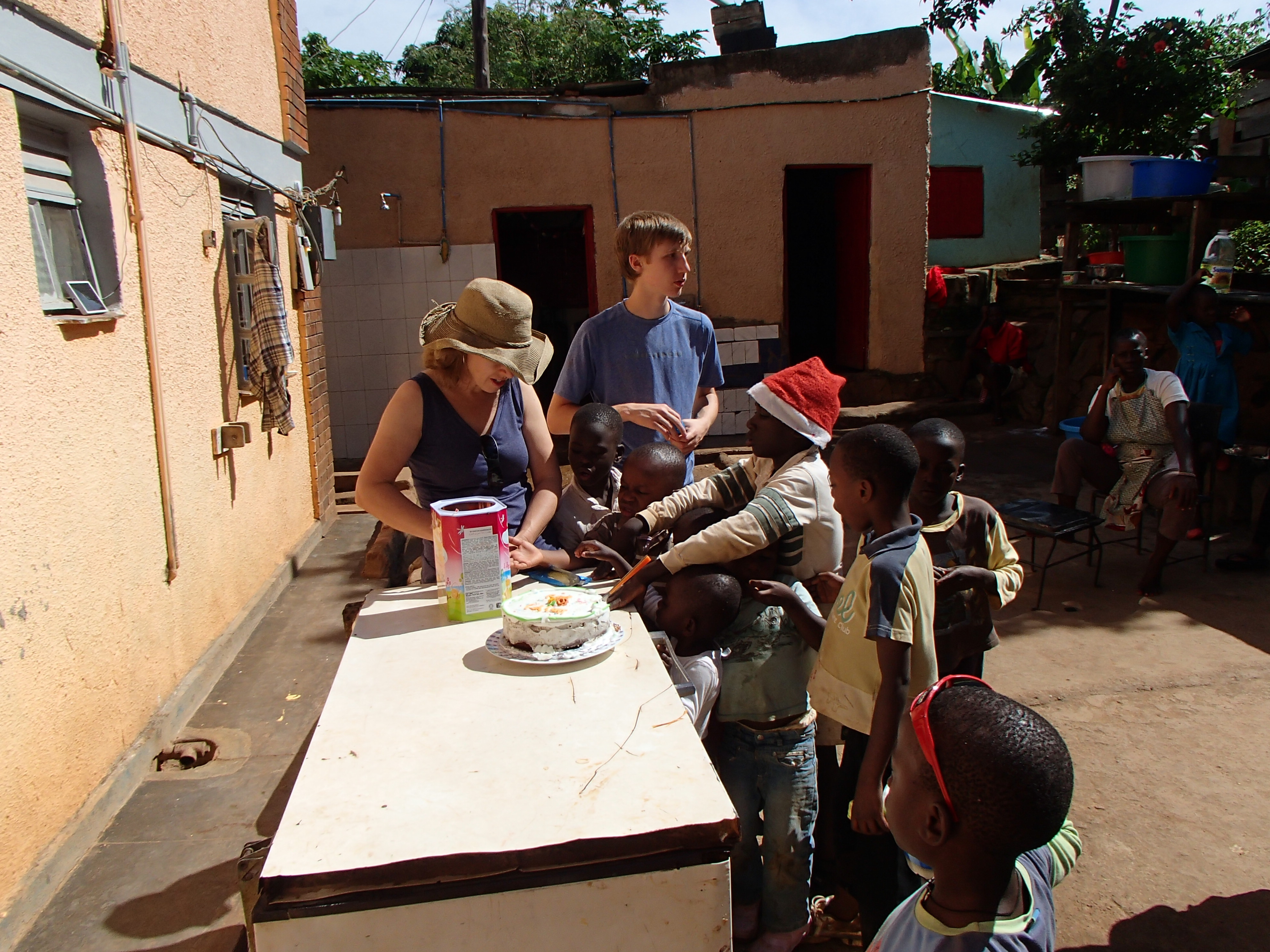
No line for cake..
-Also in contrast to our ways, our 2 month stay in South America was delightfully refreshing. Their newspapers hardly mention North Korea or Israel. Their issues are not ours. In Argentina, there is an underlying feeling that a party could break out at any moment. When people asked our nationality, we immediately said, “American.” In Argentina, Chile, Uruguay and Peru, they laughed and said, “No, we’re American!” From then on, we were “North Americans”.
-My quintessentially American husband, a former Naval officer, was unwittingly a reflection of our country each time he entered an eating establishment. While the kids and I ordered from the choices, Harry posed the same question every time, “What is the best?!”
SPORTS-OBSESSED. Other than the soccer enthusiasm displayed in South America and cricket in India, the value our society places on sports is out of whack to other cultures and to our set of needs. Worldwide, there are so few children that have free time, who aren’t working, searching for food or helping with essential survival tasks. Unlike other developed countries, our children are not spending hours drilling and striving for success on a single entrance exam. Our elite kids play organized sports. What we value is where we spend our time and energy. It wouldn’t be strange to find our families out of town at a kids’ sports’ tournament for the entire weekend. Our top students are not singled out by fine universities for recruitment with hopes of grappling with the pressing questions of our time, perhaps to further science, technology, engineering, industry. No… 9th graders have committed to college for admission or “scholarship” because they can get a ball into a net or into the end zone.

Parkour in Vietnam. Now there’s an athlete.
In stark contrast to this, I spoke with Tony, the man who runs the farm for the Malayaka House orphanage in Uganda, about Didas, a boy with tremendous athletic ability. I talked about opportunities Didas might have, if the right person were to see him in action. Tony explained that his gifts would be exploited for the school’s gain; a regular 4 year program would stretch out to 7 years or more and would be no favor to Didas personally. Tony wanted Didas to learn a skill and work on the farm. Tony prophesized, “Didas needs to go meet his fate.” Perhaps, these wise words could be for our benefit too.
FUN. The American Special Forces in Uganda are there to hunt Joseph Kony but on Tuesday nights they arrive at Malayaka House for Pizza Night. They are intelligent, outgoing, fun. One officer got on the ground to demonstrate to Leland the best way to win a lacrosse faceoff. Another, the most senior officer, gave Harry his business card in case we ran into in any trouble. Harry carried that at all times and called it his get-out-of-jail-free card. A sergeant discussed Pangea and the origin of man with Greer. Another sergeant seated next to me pulled out his plastic bag full of McCormick spices (Baltimore again) to perfect his meal. Though they did feed lollipops to the monkeys on their balcony (the monkeys unwrapped them first!), they made me proud for our association.
-American music is pervasive throughout the world, bringing with it the light and spirit that medium uniquely is empowered to do. When we arrived on the first day of our trip at 4:30 in the morning at the Entebbe Airport, our future friend, John Kafeero drove us to his guesthouse. The headlights shined through the darkness onto the men lining the sides of the streets, each holding a wooden rifle and a couple of shiny rounds, creating a terrifying reception. John snapped on the music and out came the comfort of ‘Blue Jean Friday Nights.’
-In the pouring rain and darkness at the entrance to the final leg of the Incan trail, we sat huddled with scores of other hikers waiting for the gates to open to make our final ascent to the awesome Machu Picchu by sunrise. We sat. We waited. I pulled out my iPod and cranked “Call Me Maybe” to animate the international crowd who all seemed to know the words and want to dance. Mid-song, my battery died, but the song unleashed a flash of happiness.
FREE SPEECH. It took us three nights witnessing the entire city going dark without power, except our hotel, to realize we were staying in the Indian version of a Mafia hotel. The fact that our towering building blocked the sunlight for an ancient sundial and museum should have been a clue. We had no idea how to extricate ourselves safely and endured a series of unfortunate events. Not knowing how things worked, we told our accommodation organizer AFTER we left the country.
In Vietnam, all but one enlightened guide stayed on script and showed us what we should see and told us what we should know, according to the State Board of Tourism. I have stayed in touch with this outlier and am careful what I say to this day. Even writing my friend in Israel, I censor myself. I don’t want to put anyone at risk by my association. So strange to feel this even back in the U.S. of A. Inside these and other countries, I felt claustrophobic and strained by limitations, and I was only a visitor!
NATIONAL SERVICE. Non-sequitur to this essay, but dropped in after the free speech section, is my advocacy for a national service component to American citizenry. The U.S. is an incomparable melting pot in a time when technology is segmenting us further apart by encouraging interactions only with like-minds. While this phenomenon is happening worldwide, a place of such cultural and economic diversity has to find creative solutions to keeping us all together. It is my fear that our greatest commonality is a desire for economic prosperity with freedom of speech and religion a distant second. Our national service agenda does not have to be limited to promoting our military machine. Pick a problem. Pick a bunch. Think a domestic Peace Corps and focus our “guns” on them. Service announcement over.

Philosophical graffiti
There were many times I was embarrassed to be American.
-Over dinner at the house of my Japanese home-stay family from college days, we discussed gun violence. In their city more than double the size of Baltimore, their gun violence the year prior had been zero. Ours was 235 homicides, not to mention injury.

At the fair, the ‘America’ booth sells toy guns.
We asked them their biggest crime concern and they told us with great animation about the ginormous-single-shoe thief. No, it wasn’t a giant, it was a man at the subway who was knocking down women wearing the fashion that is impossibly high shoes, stealing one shoe and running away. Yes, he is still on the loose! We were laughing uncontrollably. They were puzzled by us.
-Awakened by a loud hissing noise at the crack of dawn in unquestionably one of the living wonders in our world, our guides explained an American company gives balloon rides across the tundra of the Serengeti. Bribery is an open form of access in Vietnam, India and Africa. I don’t know about the specific company waking all of the wildlife in this stretch of wonderful in Tanzania, but knowing Africa, it’s probable. Regardless, those balloons are still an embarrassment, poor form.
Now there are many reasons we are happy to be Americans, not the least is access to running water and flush toilets. (There’s no place like home! There’s no place like home!) Seriously though, our trip start and finish accentuated our appreciation. We began our trip in Uganda, where the legislation making homosexuality a crime punishable by death just passed. By sheer chance, our trip ended in San Francisco steps away from the route of the Gay Pride Parade, 5 days after the Defense of Marriage Act was defeated.

(Ironically, I found that men are more physical with one another in other cultures. Elderly Vietnamese men held hands as they walked around the lake for the early morning exercise that most people in Hanoi participate in. Indian men would have their arms around each others necks or waists walking down the street after a cricket match.)
The Parade is a crazy scene that welcomes everyone. Some choose to attend buck-naked, just for the fun of it. What got me was the strappingly handsome, oversized police officers holding hands and celebrating their equality and validity in the eyes of the law and among their fellow citizens. We Brighams were tearful and full of pride because at least tolerance is something our country is closer to getting right. The bookends of the trip were poetic circumstance indeed.
-carter
 The Brighams Of Baltimore
You must be logged in to post a comment.